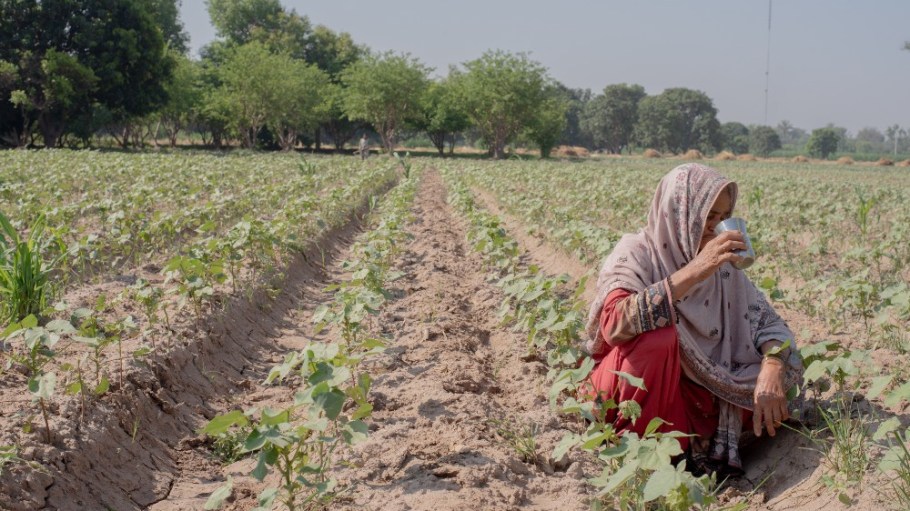
It’s spring 2026, and large parts of Western Europe have already been thrust into intense heat. The United Kingdom, Ireland and France registered record temperatures for the month of May, while wildfires were reported across several towns and cities. Meanwhile, in South Asia, the reality has become even more frightening. A recent study by a team from the University of California, Berkeley estimates that a “one-day heatwave event” in India—usually temperatures above 45 degrees Celsius, similar to those already recorded this year—could kill as many as 3,400 people.
Related Stories
Those are timely reminders ahead of today, World Environment Day, that the climate crisis is on our doorstep. Even more worrying, it has already begun to have a profound impact on agriculture around the world, which has potentially existential implications for humanity’s future. Extreme weather events threaten our ability to grow crops—and, as a result, put at risk some of our most essential needs, from the food we eat to the clothes we wear.
Across the agricultural sector, there is no hiding from the unrelenting heat that bakes much of the world’s farmland. There is no alternative but to plough on whatever the weather, producing crops that form the backbone of industries from food to fashion.
Shade facilities, clean water, and regular breaks—measures mandated by the Better Cotton Initiative (BCI) for all its certified farmers—do offer some respite but, quite frankly, we need longer-term solutions to boost climate resilience across these regions as temperatures soar year on year.
A recent report from the World Meteorological Organization (WMO), and Food and Agriculture Organization (FAO), titled “Extreme heat and agriculture,” said that in India’s worst affected areas, agricultural labor capacity could drop by 40 percent by the end of the century, significantly affecting rice farming. The paper also claimed that workers across the agricultural sector are 35 times more likely to die from occupational heat exposure than all workers in all other sectors combined. It is a statistic that will stop you in your tracks.
The organizations say that in 2021 almost half a billion hours were lost globally due to extreme heat, compromising the health and jeopardizing the livelihoods of over one billion people.
In our work supporting cotton farmers across more than a dozen countries, BCI has seen first-hand how climate change and increasingly frequent extreme weather events are reshaping landscapes from the United States to Australia and everywhere in between. One particularly high-profile case was recorded back in 2022, when Pakistan grappled with intense flooding that wiped out an estimated 40 percent of cotton. Ahead of the current 2026-2027 sowing season, the Punjab Agriculture Department and Pakistan’s Central Cotton Research Institute (CCRI) urged cotton farmers to take preventative measures to protect crops from temperatures close to 50 degrees Celsius.
Research tells us that we can expect such weather events to occur with increasing regularity. The FAO and WMO describe extreme heat as a “risk multiplier” because of the domino effect it can have on water supplies, pest infestations, biodiversity, and the potential for wildfires.
More than 50 percent of cotton growing regions face high climate risks, with the potential for harvest wipeouts like Pakistan. In the face of this reality, climate resilience must become a core pillar of the cotton sector’s development if we are to withstand and fight back against a warming planet. Not only because it will support the futures of farmers and farm workers, but because it is an essential approach to securing the futures of entire industries.
From farm to fashion
The fashion and textile sectors are a prime example of this. Complex though their supply chains may be, they are all built from the ground up, starting with raw material producers like cotton farmers. Through this lens, it is a striking reminder that climate change is shaking the very foundations of industries that serve us all.
As a multistakeholder organization working across the supply chain, BCI knows that this is not lost on our membership and network of partners who routinely support our field-level initiatives aimed at driving scalable improvements across cotton farming communities.
Our current efforts have one main goal in mind: making cotton farmers more resilient to the effects of climate change, particularly higher temperatures. One of the best ways farmers have of improving their resilience is by taking more proactive steps to regenerate the nature around them and under their feet. Regenerative agriculture, which has been the focus of many of the practices we support farmers with, now permeates our whole system, putting healing the soil and recovering local biodiversity at the top of our priorities.
Following the latest update to our standard, which came into effect in April, BCI now oversees a regenerative standard that goes further than ever to champion the practices that not only sustain but improve the natural environment that farmers depend upon. Not only does healthier soil retain moisture better and help boost the resilience of crop production, it is also a carbon sink akin to the world’s forests in its vast potential to capture greenhouse gasses and combat climate change.
Making this a success in conditions that continue to mount pressure on farm life is difficult, and speaks to the urgency of the action required, but more than one million cotton farmers are aligned with our initiative, demonstrating their commitment to creating change.
Working alongside in-country partners who regularly engage and support farming communities by tailoring the application of our standard to the environment, we are leading a number of projects using regenerative practices with the aim of helping farmers better adapt in the face of climate change.
In collaboration with climate-tech startup Planboo, BCI started a project in India earlier this year to pilot the production and use of biochar on cotton farms. Using agricultural waste that is typically burned, participating farms will produce biochar—a charcoal-like substance that can improve soil health, while boosting its water retention capacity and helping store carbon in the ground for more than a century. Planboo has recorded impressive results trialing this solution in varied farming contexts, providing a circular way to create value from waste, while improving soil health and crop resilience.
Meanwhile, in the U.S., the results are in for a group of cotton farmers who implemented a selection of regenerative practices during the last cotton season. As part of this pilot project, farmers were able to record 54 percent fewer greenhouse gas emissions than the regional average. BCI, in collaboration with its project partner Indigo Ag, has now introduced an incentives framework through which companies can directly invest in those driving this change.
The shift we are making will also create opportunities for our members who will be able to use BCI Cotton to set regenerative sourcing targets. Their role in stimulating and rewarding cotton production that protects and restores biodiversity highlights the circularity of this process, from farms to stores and consumers, then back to the field, through vital investment on an increasing number of farmers committed to safeguarding the environment.
Now the forecast is in for 2027, which is projected to be the hottest year on record. This, in part, is due to the formation of what scientists say could be the strongest El Niño in decades, called a Super El Niño. This direction of travel, however, is not new. Extreme heat does not ebb and flow, it is not random. The past 11 years have been the warmest since records began, reflecting a clear and dangerous pattern.
While the trajectory may seem unstoppable, the effects of it do not have to be. The opportunities are there, but farmers must be supported, financially backed, and empowered by us all. With the right support, they can be stewards of the environment, rather than the first victims of the climate crisis. Rising tides lift all ships, so we must all rise to the challenge of protecting and stabilizing the bedrock of these industries.
Lars van Doremalen is the Director of Impact at the Better Cotton Initiative (BCI), where he leads the organisation’s work to translate sustainability commitments into measurable change at field level. His focus is on strengthening how impact is defined, evidenced and delivered—ensuring outcomes for farmers, their livelihoods and the environment are both credible and realized in practice.
Working at the intersection of agriculture, data and partnerships, Lars specialises in building the impact architecture that connects strategy, field implementation and value chain accountability. His work spans priorities such as climate, regenerative practices and farmer livelihoods, ensuring they are grounded in robust evidence while remaining practical and scalable for farmers.
With over 15 years of experience across corporate finance, consultancy and international development, he brings a systems perspective to scaling more rigorous and transparent approaches to impact—firmly rooted in what works on the ground.