Ocean spot freight rates are accelerating at their fastest pace since last June in a sign that the August-to-October peak shipping season is starting two months early.
According to the Drewry World Container Index (WCI), 40-foot container prices surged 23 percent to $3,433 from the week prior on the back of increases on the trans-Pacific and Asia-to-Europe trade routes.
Containers traveling from Shanghai to Los Angeles saw average prices rise 31 percent to $4,565, while Shanghai-to-New York cargo prices jumped 20 percent to $5,505 per 40-foot container.
Related Stories
Lars Jensen, CEO of container shipping consultancy Vespucci Maritime, said the Los Angeles-destined freight figures marked the fourth time ever that rates have increased more than $1,000 in a single week.
On the Pacific, rates have been gradually increasing for 14 weeks, capping off with this week’s boom. In total, rates to the U.S. West Coast are up 108 percent in this period, while rates are similarly up 99 percent.
The Drewry numbers follow a report from the Shanghai Containerized Freight Index (SCFI), which measures export cargo out of the Port of Shanghai across 15 international trade routes, that benchmarked a sharp 15.9 percent rise to 2,572 points.
Ocean carriers are blanking fewer sailings due to the heavy container demand. According to Drewry’s Container Capacity Insight, only three blank sailings have been announced on the trans-Pacific for next week. The consultancy says this is “significantly fewer” than previous weeks—carriers had blanked eight sailings last week—as the industry anticipates stronger cargo volumes.
Drewry attributes the demand uptick to shippers pulling forward bookings ahead of potential U.S. tariff changes expected in July, as well as additional cargo demand linked to the 2026 FIFA World Cup.
Last week, Seko Logistics noted that demand had spiked as ocean carriers and shippers delayed their contract negotiations due to the cost volatility associated with the disruptions at the Strait of Hormuz. The company recommended shippers to secure space four-to-six weeks in advance due to the anticipated shortage of cargo capacity.
Space on carriers is largely booked through the end of June, with pent-up demand also stemming from China’s Golden Week holiday to kick off May.
On Monday, container shipping market analysis firm Linerlytica said the strong rate momentum looks set to last at least until the end of July. The firm noting that carriers are cashing in on the demand to push another series of rate hikes in mid-June following the application of successful June 1 general rate increases and peak season surcharges.
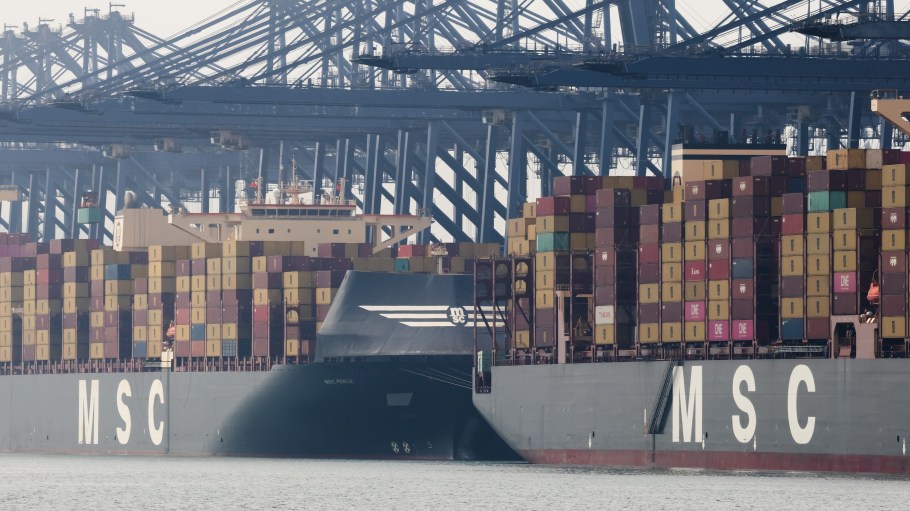
Mediterranean Shipping Company (MSC) is taking advantage of the high-rate, high-demand environment by bringing back a premium service it shelved last July.
The world’s largest ocean carrier by tonnage plans to reintroduce its Pearl service, which travels from China’s Yantian and Xiamen ports to the Port of Long Beach. The service’s first voyage from Yantian will depart June 14 via the Liberia-flagged 4,963-TEU MSC Lyse V. That route will last 16 days.
Pearl includes MSC’s second call from Yantian to the U.S. West Coast, with the container line’s Chinook trans-Pacific service also calling the Chinese port.
“We are continuing to see a strong supply/demand balance in favor of the carriers as an early peak is clearly gaining momentum,” said Jensen in a post on LinkedIn Friday morning. “Rates are not quite up to the peak levels seen last year, but they are approaching it.”
At the time, rates escalated substantially due to a pause in the U.S. China trade war. In just one week between May 29 and June 5 last year, rates across all trade lanes skyrocketed nearly 41 percent to $3,527 per 40-foot container.
While the restriction of traffic through the strait directly resulted in the tightening of global oil supply, thus forcing carriers to pass on higher freight rates, Jensen pointed out that the Hormuz situation had an indirect effect impacting ocean freight capacity in other trade lanes.
“The Hormuz crisis is the reason why the Red Sea crisis is not resolved,” said Jensen. “It is the detour around Africa due to the Red Sea crisis which continues to absorb a large amount of vessel capacity. Keep in mind that prior to the Hormuz crisis we were beginning to see a slow reversal back to the Suez routing…In the past week we have seen the Iranian military state explicitly that if the conflict escalates, they want to close Bab el-Mandeb same as they have done for Hormuz.”