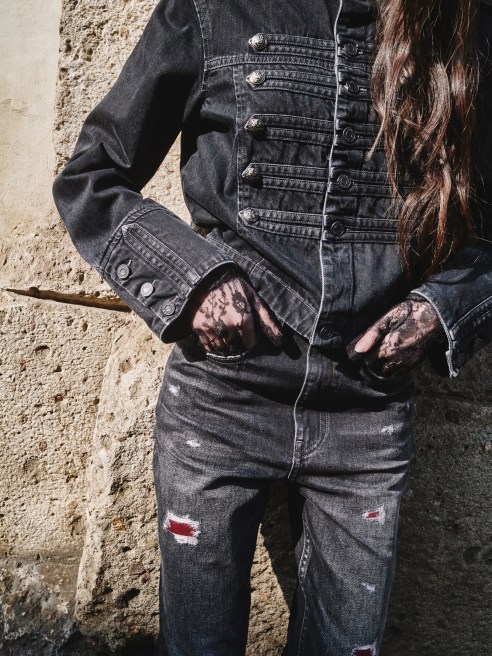
For Fall/Winter 2027–2028, denim mills are redefining what sustainability looks like—moving beyond incremental improvements and one-off collections toward fully integrated, end-to-end solutions that are measurable, traceable and scalable.
Approximately 70 percent of Maritaş product portfolio is based on sustainable sources and the Turkish mill has a clear roadmap to reach 100 percent by 2030. “We approach sustainability as a fully integrated design philosophy, beginning at the raw material level and extending across the entire production ecosystem,” said Fatih Kesim, Maritaş general manager.
Related Stories
Despite supplying denim fabrics to global brands, the mill is increasingly embracing a localized approach to sustainable agriculture. Its natural indigo project in Turkey reflects its commitment to reducing chemical impact while preserving the authenticity and depth of traditional denim aesthetics. Another key highlight for F/W 27-28 is the mill’s continued expansion of its pioneering regenerative cotton project in Turkey.
“Alongside certified regenerative cotton, we maintain a strong offering of organic and recycled cotton options, ensuring both environmental responsibility and scalable solutions for the industry,” Kesim said.
Taking a farm to fashion approach is the way forward, especially as suppliers are under more scrutiny.
“I think what’s really changed for Fall/Winter 2027-2028 is that sustainability is no longer something we add on—it’s where we start from. Every development now must meet a certain level of environmental and compliance credibility before it even becomes a design discussion,” said Imran Tanveer, Crescent Bahuman’s vice president of fabric product development and sales.
At the same time, there is growing pressure to ensure that all developments align with digital traceability frameworks is becoming increasingly important—particularly as Europe advances toward the implementation of digital product passports.
Crescent’s strategy relies on working extensively with regenerative cotton programs, where traceability is built in from the farm level. At the same time, Tanveer said the mill is advancing cellulosic blends like Tencel Lyocell – HV100 and Indigo Dyed Modal, but in a much more controlled way to retain the authentic denim look.
“In terms of processes, there’s a strong shift toward alternative indigos and closed-loop systems where dye recovery is significantly improved. Finishing technologies like zero water finishing are now standard in our development toolkit, allowing us to dramatically reduce water and chemical usage,” he said.
Soorty’s Second Life denim-to-denim recycled cotton is playing an important role in providing clients with traceable regenerative fibers. The fiber closes the loop on both post-industrial and post-consumer waste. For F/W 27-28, the mill applies Second Life recycled cotton to hemp and Tencel blends, resulting in tactile fabrics with neps and irregular surfaces.
Eda Dikman, Soorty’s group general manager-marketing communications and branding, said imperfections are the goal. “[These] fibers carry their own character in constructions that let them look and feel their best without trying too hard,” she said.
Denim mills are showing their support for Lenzing’s Tencel Lyocell – HV100 in a meaningful way for F/W 27-28. This variation of Tencel is engineered in cut lengths from 10 to 28 millimeters, enhancing the fabric by mimicking the texture, irregularity and authentic feel of natural fibers. It also eliminates the shine that traditional Tencel is known for.
Advance Denim, Naveena Denim Mills and Bossa are among the mills using the wood-based fiber in collections.
Fabrics made with Tencel Lyocell – HV100 reflect a balance between natural aesthetics and considered performance, according to Berke Aydemir, Naveena Denim Mills’ head of R&D and technical sales. “It mirrors the authentic visual character of cotton—bringing in irregular slub textures and a natural look—while offering a softer handfeel and improved moisture control,” he said.
The fiber also supports mills’ efforts to implement more responsible material development. Tencel Lyocell – HV100 reduces carbon and water impact by 50 percent and is produced in a closed-loop process with 99.8 percent solvent recovery.
“It’s a development that aligns closely with the mood of the season—where materials are expected to feel real, comfortable, and thoughtful, not just innovative for the sake of it,” Aydemir added.
Mark Ix, Advance Denim’s director of North America marketing, added that mixed with cotton and linen Tencel Lyocell – HV100 “creates the ultimate in understated luxury.”
Mills are also looking for ways to help stretch denim align closer to their sustainable goals.
One of Calik Denim’s key highlights for the season is Bio Form, a new concept integrating bio-based elastane and bio-based auxiliary chemicals into fabric constructions. Eray Karaduman, Calik’s newly appointed general manager, described the technology as a key step toward lowering the carbon footprint of stretch denim while maintaining expected performance standards.
He added that Bio Form “significantly reduces reliance on fossil-based raw materials while maintaining the mechanical performance required for modern denim—particularly in elasticity, recovery and durability.”
Naveena Denim Mills is also introducing a collaboration with The Lycra Company featuring the new bio-derived Lycra fiber—the first elastane at scale made with renewable content. Made with 70 percent renewable content and reducing CO2 emissions up to 44 percent, Aydemir noted that it is a drop-in solution with no need to re-engineer fabrics or patterns.
“This innovation brings a meaningful shift in how stretch is produced, without changing how it performs,” he said.
With responsible materials leading the way, Tanveer summed up the season as being more grounded, intentional and confident. He likened int to “quiet innovation,” or products that are highly considered, technically advanced and sustainable, but not loud about it.
“There’s a clear move away from over-designed, over-processed denim. Consumers are looking for honesty in materials, durability, and longevity,” he said.