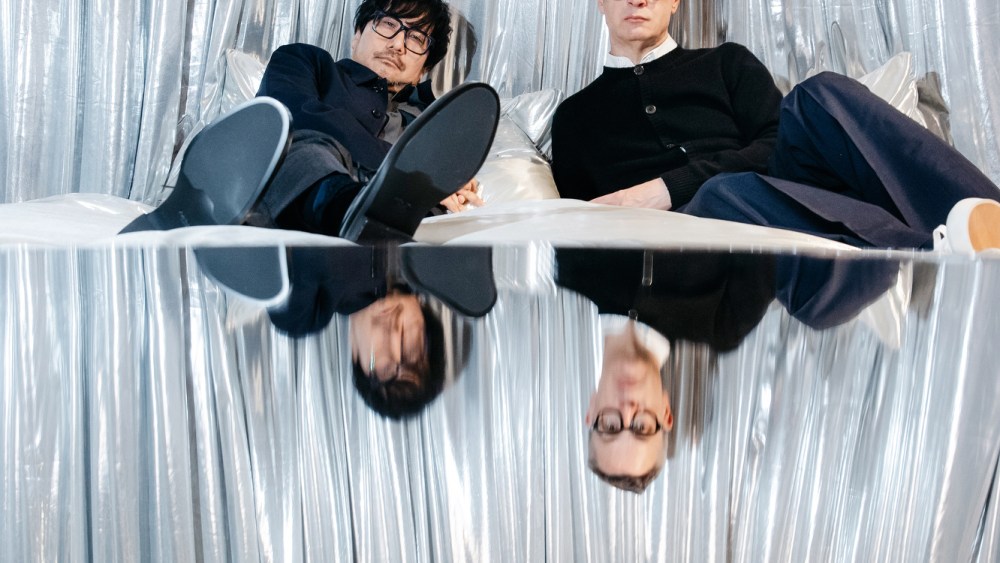
For many visitors, paying a visit to Prada Mode at Hotel Chelsea is as simple as taking the subway to 23rd Street. But, if you’re Nicolas Winding Refn and Hideo Kojima, there’s a more interesting way to get there. By spaceship.
And the duo have already landed.
Refn recently debuted a short film previewing their concept at Cannes. In the film, the two creatives don silver Prada-branded spacesuits as they embark through space, finally ending their intergalactic journey in the hotel lobby.
Related Articles
“I’ve written a lot of scripts in hotel rooms,” says Refn from Copenhagen, a few days before heading to New York for the opening of Prada Mode. “The idea of rooms and history and transportation and UFOs and aliens — which is so much of mine and Hideo’s own obsessions from our youth — it just felt like a natural way of, well, if we were two astronauts flying in silver suits through space, we would end up landing on the Chelsea Hotel.”
You May Also Like
Prada Mode takes place June 3 through 7, with the first two days structured as a private members club before opening to the public. Members club programming includes conversations, workshops with beloved Nordic bakery Juno, music performances and dining, as well as an online streaming component, Prada Mode Channel, filmed in themed studios. Topics of conversation will span ghosts, UFOs and a review of Wednesday’s opening night after party at Katz’s Delicatessen.
Prada Mode, which the pair described as “highly personal,” is rooted in a metallic silver color palette, from staff uniforms to seating, room decor and even a vending machine that offers guests tangible artifacts (stickers and more) from the experience. For the pair, silver was inherently linked to their interest in sci-fi, space and television, and symbolized their feeling of being two satellites orbiting around the world and each other.
Titled “Satellites II,” the immersive installation follows the first part of the project, “Satellites,” unveiled in Kojima’s hometown of Tokyo last summer at the Prada Aoyama Epicenter. For “Satellites II,” the duo turned their attention to the city where Refn grew up creatively.
“It’s a very personal odyssey for myself, to come back to a city that created me. Even though I was born in Denmark, you can say I’m a product of living in New York,” says Refn, known for directing films including “Drive” and “Pusher.” “The Chelsea became one of the few places left of my quote-unquote ‘childhood.’ Not that I ever went into it,” he adds. “But there was a comic book store next to it — that’s obviously now long gone — that I would always go to once a week.”
Kojima describes the hotel as a “gravitational field” for musicians and artists throughout its history. “We felt certain that this was the center stage for creators,” says Kojima. “While it has operated as a hotel, many people have also lived here, and artists from around the world have come to create within its walls. This hotel is a ‘time capsule,’ holding the history of artists from across the globe. The building itself stands as a living witness.”
In addition to its historical and creative significance in the city, the hotel was ripe for the pair to explore the idea of a domestic space that’s transient, and ephemeral, in nature. The concept for “Satellites” is rooted in an exploration of analogue nostalgia and digital preservation, with the memory of cable television at its core. For Prada Mode, the pair chose to focus on “nostalgic technologies that once defined the golden age of New York,” says Kojima.

“ The whole concept of ‘Satellites’ is analogue, and fetishizing analogue,” says Refn. For the first edition of “Satellites,” Refn and Kojima explored the idea of conversation between televisions, specifically retro televisions that featured recordings of themselves in conversation exploring the idea of human connection.
“Which is really all about failure. Failure as a father, failure as an artist, failure of life. All the things that make us human. And so it’s very analogue in its core,” adds Refn. “And so when we brought it to New York here for Prada Mode, we extended it and expanded the whole concept, setting up a cable station like I used to remember watching in New York back in the ’80s, which was purely analogue. What you saw is what you got, and you just had to wait till it was over for the next thing to happen.”
And part of the analogue experience is being there in person.
For those who are unable to make it to Prada Mode in person, Prada Mode Channel offers another way to experience the concept, in the same way that cable TV once offered: you have to tune in when it’s happening, otherwise you miss it. Scheduled programming reflects the duo’s own sensibilities and interests; some segments will be filmed in various themed rooms: the silver studio, cloud studio and spaceship studio. There will also be screenings of films like the 1950 noir film “Guilty Bystander.”
While the tensions between digital and analogue experiences and storytelling are on display throughout Prada Mode, the pair introduced another dimension to the experience: artificial intelligence. “Satellites II,” the short film, was created using generative AI.
“When it got time to make ‘Satellites II,’ the actual film, it was the idea of all the things that we grew up with that was analogue-driven, but recreated through an AI sensibility,” Refn says, comparing the advent of AI to the shift between analogue and digital in film: no one knew where, exactly, it was going to take society and culture.
“I think it’s something that we have to be very careful of, and I personally believe in very much control of it,” Refn adds. “From a personal level, it’s an amazing canvas, and there are so many things you can do within that canvas that is very fascinating. Artistically, it’s very exciting.”
Although Prada Mode staff are all dressed in metallic silver outfits that match the physical decor, the overall fashion connection is more conceptual than literal. As visual artists, both men are focused on aesthetics, and view fashion as a way to convey attitude and effect what the viewer sees and feels.
“Both Hideo and myself are very good at objectifying sensibilities. We’re very attracted to physical objects all around us. We’re both massive collectors of stuff,” says Refn. “From the fashion perspective, that idea of fetish and clothing and visuals is very much what we do. He makes video games, I make film and television. We’re very dependent on the screen. We’re screen addicts, as you can say, because that is our canvas.”
Refn and Kojima met more than 15 years ago, after the video game designer reached out to meet up in London. The pair have grown close in the years since, although they’ve never directly spoken, speaking only through a translator and communicating through music and images.
While the pair have previously made cameos in each other’s work — Kojima has appeared in Refn’s films “Too Old to Die Young” and “Copenhagen Cowboy,” and Refn has been made into an avatar for several of Kojima’s video games — Prada Mode marks their first equal collaboration, and the short film marked their first time sharing a screen within a narrative project.
“It’s difficult for us to truly collaborate, because our ideas inevitably clash,” says Kojima. “We’re both the type of people who want to see a work through entirely on our own. This installation comes from a very different place, quite removed from our intentions. Instead, we were forced to confront our inner selves with honesty and laid those thoughts bare for the other to see.”
Just as Refn and Kojima have inserted themselves into the narrative, Prada Mode visitors become part of the installation, an experience that is inherently analogue in nature.
“Actually staying at the hotel and freely, actively engaging with the installations — this is something that simply can’t be replicated digitally,” says Kojima. “By physically inhabiting the space and moving through real, lived time, you encounter different people and programs, and there’s a sense of mutual stimulation that occurs. It’s an experience you can’t get from anonymous interactions on the internet.”
“When it comes to the works we each produce, our creative outputs are completely different. However, we share a dissatisfaction with the current state of art and entertainment, and a desire to create something new — something with a perspective that doesn’t yet exist — and to inspire the younger generation,” Kojima adds. “We also have a deep mutual understanding of the ‘isolation’ that comes with being a creator. It’s a very particular feeling: something you can’t fully share with friends or family. Being able to share that is quite significant for us.”
In addition to Hotel Chelsea, Prada Mode will extend downtown with site-specific installations at Katz’s and at the Prada Broadway Epicenter, and a Japanese Anime Festival screening curated by Refn and Kojima at the Angelika Film Center.
Shortly before Prada Mode opened its doors to its first visitors on Wednesday morning, Refn shared a preview of what might be next for the duo — and Prada Mode.
“The only place we can take ‘Satellites III’ is Mars,” Refn told the crowd during an introductory panel at the hotel alongside Kojima. “So we’re waiting for the offer.”