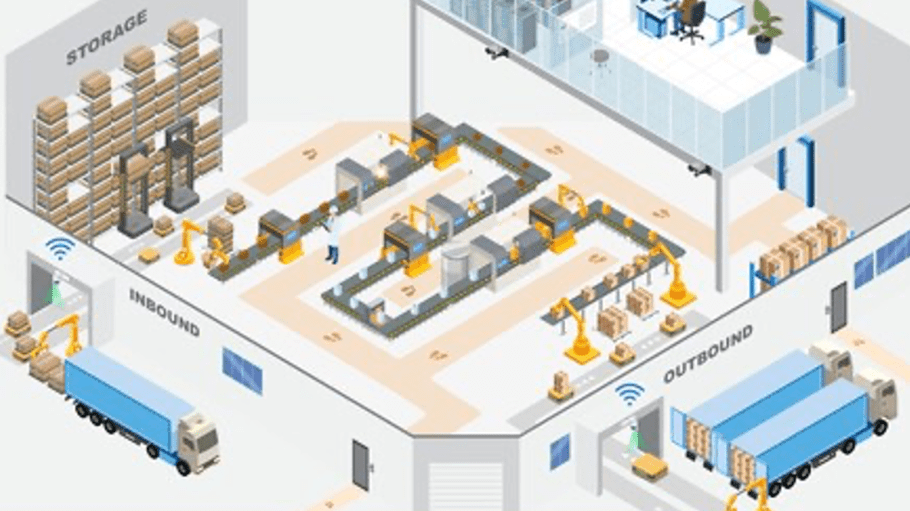
The factory of the future will be powered by artificial intelligence and will feature more advanced automation than is currently available. And, according to a new Boston Consulting Group (BCG) report, the companies that succeed will be the ones that reimagine production systems and operations from end to end.
The authors of the report, titled “How the Factory of the Future Is Reshaping the Economics of Manufacturing,” said AI and advanced automation are already fundamentally rewriting the rules of worldwide competition. The report is based on a survey of 1,000 global manufacturers and was created using proprietary economic modeling. The report emphasizes that manufacturing competitiveness is no longer determined by simple, static comparisons of local labor costs.
Related Stories
Instead, it is defined by a company’s ability to holistically and completely redesign production systems. This shifting dynamic is driven by three converging technological breakthroughs: the proliferation of complex agentic systems, a thousandfold expansion of computing power over the past decade and the maturity of physical and virtual AI, which has notably reduced robot training times by 70 percent while expanding automatable tasks by 50 percent.
“Manufacturers are entering a new era where competitiveness is no longer defined by static cost comparisons, but by how effectively they can redesign production setups end to end,” said Daniel Kuepper, BCG managing director and senior partner, fellow at the BCG Institute, and coauthor of the report. “The factory of the future is fundamentally changing how companies create value and how they think about where to produce.”
By orchestrating new technologies into an integrated ecosystem, the “Factory of the Future” (FoF) yields a compounding effect that triggers simultaneous improvements across energy consumption, materials usage, yield and throughput. The report noted that this system-level overhaul unlocks massive productivity gains of up to 60 percent, significantly compressing (and in some cases entirely reversing) the traditional cost advantage held by low-cost countries.
Consequently, upgrading to FoF capabilities within high-cost nations can now prove more economically viable than offshoring. While this requires a change in mindset and financial allocation, the report’s authors said the stakes of ignoring this shift are exceptionally high. The report warns that Western Europe risks losing up to $1.03 trillion in manufacturing value to relocation, while the U.S. has roughly $440 billion at risk if local facilities fail to transition.
The report outlines a more dynamic, variable global manufacturing landscape where footprint decisions must be fused with advanced technology deployment. The benefits of this transition are highly dependent on sector characteristics and regional capabilities.
For example, industries tied to high logistics expenses, such as food and beverage, benefit heavily from deploying advanced factories closer to their consumer base, while high-cost locations reap the most reward from automating labor-intensive processes. To sustain these advanced production models, BCG said access to specialized talent and digital infrastructure has become a critical baseline requirement, prompting CEOs to align their geographical footprints with cutting-edge manufacturing capabilities to remain viable in the decade ahead.
“Companies that integrate footprint strategy with advanced manufacturing capabilities will be best positioned to compete in the decade ahead,” Kuepper said.