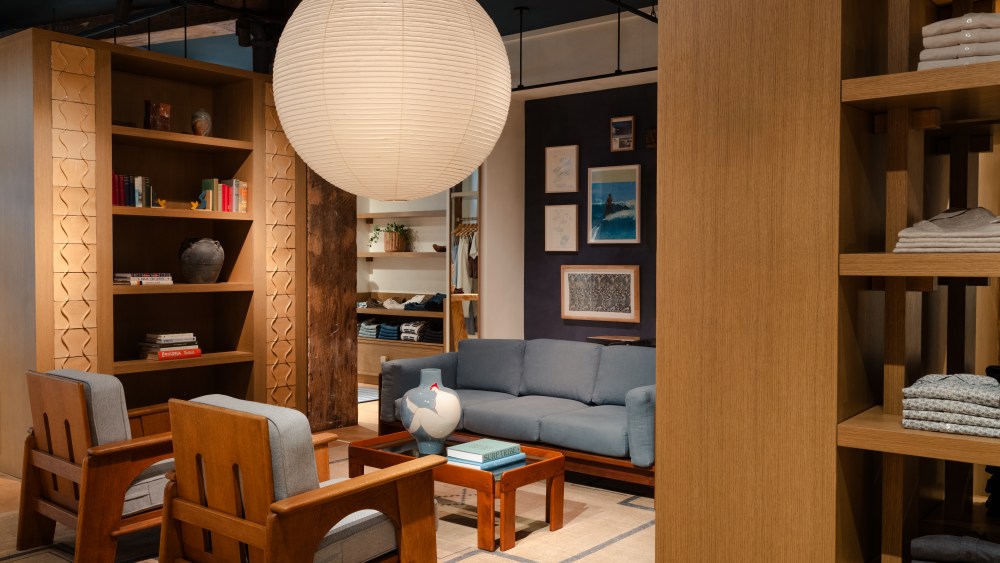
As the Faherty brand continues to expand, the family-owned business is taking a page from the luxury world and beginning to lean into a flagship concept.
The first evidence of the new strategy is at its SoHo store at 133 Prince Street. Faherty has had a store in that location since 2018, but when its neighbor, Outerknown, closed, the company jumped at the opportunity to expand.
“We went two wide and gutted the whole thing,” said Mike Faherty, cofounder and chief creative officer. Although the brand operates six stores in New York City, including one farther east on Prince Street, this was considered a prime location.
Related Articles

“It’s prime SoHo, New York City,” he said. “It felt like my hometown. I felt like the fashion capital of the world. And you don’t often get a double wide on Prince Street in an old landmark loft building.”
You May Also Like
Faherty said he’d actually been envisioning what the next generation of stores could look like. There are currently 89 units in the U.S., including one in Biarritz, France, that opened in March. “We’re taking the step to be the next great brand and we’ve got to have a home base that has a more-global expression. So when the store next to us closed down, I thought this would be the perfect opportunity.”
The first step was to find the right design firm. His decision: Brooklyn-based Home Studios. After what Faherty described as “a two-year journey” with Home Studios’ founder Oliver Haslegrave, the result is an elevated interior that is both rich and warm.
“It’s an homage to beach culture, Japanese craftsmanship and midcentury style,” he said.
Custom-built displays paired with vintage furnishings and sculptural objects create an environment that feels like it’s been there a long time. A 1980s Afra and Tobia Scarpa Bastiano sofa in walnut sits alongside a 1960s Scarpa coffee table for Cassina, while a pair of 1930s–1940s Bas van Pelt chairs in oak and a solid wood chest in the style of Pierre Chapo and two Brutalist chairs are key elements in the space.
These vintage pieces are complemented by contemporary and custom pieces including display tables by Vince Skelly, custom ceramic tile by Claypond Studio, paintings by Lukas Geronimas and hand-applied plaster finishes by Ben Lai.
“There’s a real sense of lived-in ease, but also something elevated and considered,” Faherty said. “That duality is very much at the heart of the brand. We wanted it to feel warm, inviting and a little unexpected — not just a place to shop, but somewhere people can spend time, connect, and really experience the brand.”
Faherty said that he expects elements of this design to be incorporated into some of the company’s other units as well as the shops it operates within wholesale accounts.
But next up for the brand is the revamping of its Charleston, S.C., store on King Street, which just began renovations to become the second flagship. That store, he said, is the largest in the fleet and boasts the highest foot traffic. Faherty hired a local design firm there to convert that unit.
“It’s going to have its own identity and be shaped and designed with intentionality,” he said. “We want to give a localized approach. I’m learning from the luxury legends who don’t cookie-cut their flagships. They find beautiful, interesting architects and designers to help them manifest the right vision for that brand in that location.”
Beyond Charleston, Faherty said he’s not really thinking about what other stores could be turned into flagships. “I’m focused on Charleston, but I’m sure there are going to be more,” he said.
Faherty founded the brand with his twin brother Alex in 2012 as a sustainably sourced East Coast-skewed men’s sportswear collection that offered an alternative to the brightly colored California surf brands.