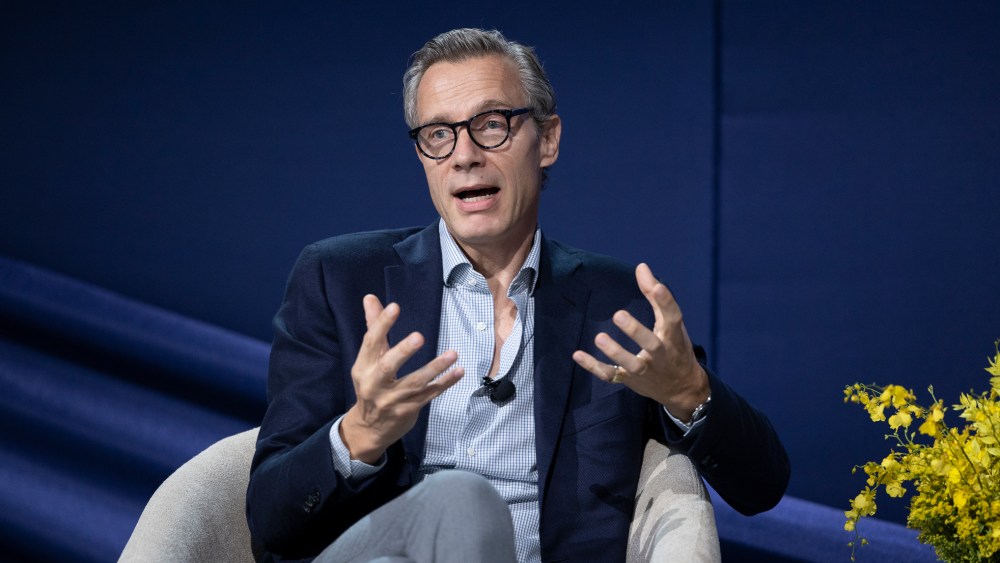
Saks Global is almost free and clear of bankruptcy court.
Judge Alfredo Pérez in Houston gave the luxury retailer’s reorganization plan the green light on Friday, clearing the way for its imminent exit from the Chapter 11 process.
For Saks Global, it’s been a relatively quick five months in bankruptcy after a drawn-out year of decline as former management sought to right operations after the $2.7 billion deal to buy Neiman Marcus Group left the retailer mired in debt.
Related Articles
Now Geoffroy van Raemdonck, chief executive officer, is ready to finally turn to what’s next.
You May Also Like
In an exclusive interview, van Raemdonck told WWD: “What’s next is really a Saks Global that has three incredible banners, that will have a strong capital structure with 75 percent less debt, that will have sufficient liquidity with about $700 million of available liquidity and that will have realized a lot of the synergies from the merger.”
Van Raemdonck, who took the helm as the company filed for bankruptcy on Jan. 13, described it as “an incredible foundation.”
“One of the reasons I came back is I could not imagine a world without having a strong Saks, Neiman and Bergdorf that build the [luxury] ecosystem — because all the brands, big and specifically small, benefit from what Saks Global has to offer,” he said.

Certainly the company is now giving the market a different look than the old Saks Global — a name that could be retired, especially as the business center of gravity has changed over the course of the bankruptcy, which led to the Saks Fifth Avenue chain being cut in half and most of the Saks Off 5th stores being shuttered. The company now has 33 Neiman Marcus doors, 15 Saks units and, the uber-luxury jewel in its crown, Bergdorf Goodman.
The CEO declined to talk about any potential name change, but is feeling good about the timing of the company’s emergence.
“In all the conversations I’ve had with the brand partners, the luxury market and the luxury brands are looking at the U.S. as a market of growth and we are the gateway to the U.S. luxury customer. The conversations we’ve had over the last six weeks with the CEOs have been very much around: What is the three-year plan to grow through you and with you? And ‘How do we expand distribution? How do we activate to new customers?’ Many brands have a new creative director and they’re looking to reach the customer with that new creative vision. The brands are continuing to accelerate their growth and they’ve continued to grow and so they’re looking for accelerated growth with us. We have access to a luxury customer that is very valuable to those brands.”
The reorganization plan was approved over the objections of former CEO Marc Metrick and former executive chair Richard Baker, which argued that the indemnification that they had under their separation agreements earlier this year was being stripped. Judge Pérez overruled those objections, leaving them more exposed as the litigation trust set up during the bankruptcy looks for lawsuits they can bring to recoup funds for unsecured creditors.
Saks Global is now ready to focus on again on what it does best — luxury retail.
Already the retailer is doing much better than it was.
“This year our plan calls for being profitable,” van Raemdonck said. “Our plan calls for $85 million of adjusted EBITDA this year and we are significantly ahead of that plan so far.”
And while the company has already suffered the ills of the merger with Neiman Marcus, it’s now ready to enjoy the benefits of the scale and efficiency the combination allows.
“Every time we regain sales on a smaller cost base, the flow through is really big,” van Raemdonck said. “And so that’s why next year our profitability is almost four times what it is planned this year. There’s such a flow through and the full year benefit of some of the actions we take this year wrap next year.”
Saks Global also, once again, seems to have regained the support of many vendors. That includes large vendors sitting on the committee of unsecured creditors, like LVMH Moët Hennessy Louis Vuitton and Kering, that agreed to the reorganization plan as well as the roughly 500 “critical vendors” who agreed to trade terms with the company through the bankruptcy process.
“The brands have also made a leap of faith and demonstrated that they believe in this business because the brands continued to ship pre-petition despite the fact that they were not paid and then they quickly rebounded in shipping with us,” van Raemdonck said.
By 2030, the company expects to have $9 billion in total gross merchandise value.
To hear van Raemdonck tell it, Saks Global is not so much changing as returning to itself and its original purpose.
“The business model hasn’t changed,” he said. “It’s refocused. So we are very focused and to be devoted to the luxury customer and focused on retail and retail experience. There were a lot of things we did in the past that were not focused either on luxury full price or on retail. We had development activities, we had an off price business and I think that’s really the refocus.
“We can operate from a position of leadership and strength and where we can be profitable,” he said. “We’ve really looked at the markets where the luxury customer is and then we’ve looked at our stores where they are strong and that’s the network we’ve chosen to have. And in many markets we have actually two stores and they’re the best, strongest markets. In some markets, one banner was bigger than the other one and the customer had voted which banner they liked most. In other markets we realized that the volume wasn’t there and the profitability wasn’t there.”
The vast majority of the company’s vendor relationships are wholesale, although the Saks chain’s penchant for consignment and concession agreements has left a legacy of deals with designers, which in some cases cover just one door, he said.
“We believe we are best at buying what’s right for our customer and we believe that our customer expects us to serve them across all brands,” he said. “And that’s the strength we have is when you come and see one of our sales associates, they’ll pull from all categories and all brands, what’s right for you, which you lose when you are in a concession model.”
Forty percent of Saks Global’s revenues come from customers who spend $36,000 annually with the company annually, and van Raemdonck said 90 percent of those shoppers are retained.
“If you’re a brand, you want access to that customer because that’s the true luxury customer and the brands all aim to elevate themselves,” he said. “And we have 1,500 sales associates who sell more than $1 million, but on average sell $1.9 million each. That is the size of a small store or a small brand luxury store and we retain more than 90 percent of those and they have 10 years of tenure with us. That is really the stickiness we have and why the brands want to grow with us, especially today where the U.S. market is big.”
Van Raemdonck has been through the bankruptcy process before.
He shepherded Neiman Marcus Group through its COVID-19 era bankruptcy in 2020 and brought that company back into the market with a relatively stronger position.
As (bad) luck would have it, Neiman’s went through the process again for different reasons, but van Raemdonck is now emerging again with something that he could have only hoped for last time. Instead of just Neiman’s, he now also has the good half of the Saks chain and Bergdorf’s — a potent slice of the American luxury department store scene.
When Neiman’s emerged in 2020, he recalled: “We didn’t have the benefit of having three very strong banners. We are leaner from a cost base, but also when we invest in supply chain, in technology, we can scale it across three banners. In the past, it was either one or two banners. So we are really in a very different place from what’s possible for us going forward.”
Many things are possible in retail — but only if one has the inventory.
After the flow of shipments became a trickle late last year, van Raemdonck said inventory is currently 15 percent higher than it was a year ago and is building back up.
“That’s encouraging, but we need to continue to rebuild the inventory in all categories with all the brands and grow our top line,” he said. “Once we do this –– and we believe that the next 12 to 18 months are about regaining where we were at our best before the merger –– then we have the ability to really transform and reimagine what luxury retail is.”
Saks Global’s prior management talked a lot about resetting luxury retail, but never really got a chance to carry out any of those grand plans.
Van Raemdonck isn’t ready to talk about his own master plan, but pointed to the many “unique assets” the company has, including the multi-brand nature of the business, its sales force, its white glove service, its horde of luxury shopping data and more.
“The customer buys products, but where we really see the difference is when they feel there is an experience, be it an event, going to a restaurant,” he said. “We sell emotions and that’s why we use the [term] customer devotion. We love our customers and we obsess about delighting our customers.”
And the shoppers love Saks and Neiman’s back, but perhaps for different reasons.
“We’ve made the choice, and it’s a very clear choice, that both Neiman and Saks have a right to exist,” the CEO said. “They have a long history and they speak to different customers who have different affinities. You see that in the seven cities where we have two stores … there’s an overlap of customers that is between 11 percent and 15 percent. You take Beverly Hills, you take Bal Harbour and you literally can see both stores from one angle and you have that low overlap. The customer has decided that [Saks and Neiman each] mean something different for them and our goal is to continue to differentiate them. I would love to hear from customers, ‘I go to Saks for this reason and I go to Neiman for that reason.’”
Bergdorf’s, which was on the block as the old Saks Global raced to raise money, remains “a key asset in the constellation of banners that Saks Global has,” he said. “This is really a unique asset and we value and are going to continue to cherish and develop it. And then, like every asset, be it a banner or stores, we’re always going to strategically assess how it fits in our portfolio, but there’s been no action today to do anything different than managing it to its best and brightest.”
This time around, van Raemdonck is working again with financial owners who picked up the company in bankruptcy — Pentwater Capital Management and Bracebridge Capital, which put up the funds the company needed to see it through the process.
“Our capital partners have been extremely supportive,” he said. “They had multiple choices and they made the choice to commit to $1 billion of liquidity during the bankruptcy and $500 million at emergence. That’s quite remarkable when you look at where we were in December and in January.
“Ultimately their goal is to make sure that we are on stable ground and that we continue to build on the foundation,” he said. “We’ve made enormous progress. There’s more progress to make and that’s really their focus. Ultimately, they’re not the natural owners of this business and there will be a moment where they will look to find long-term shareholders, but that’s not the topic today.”