
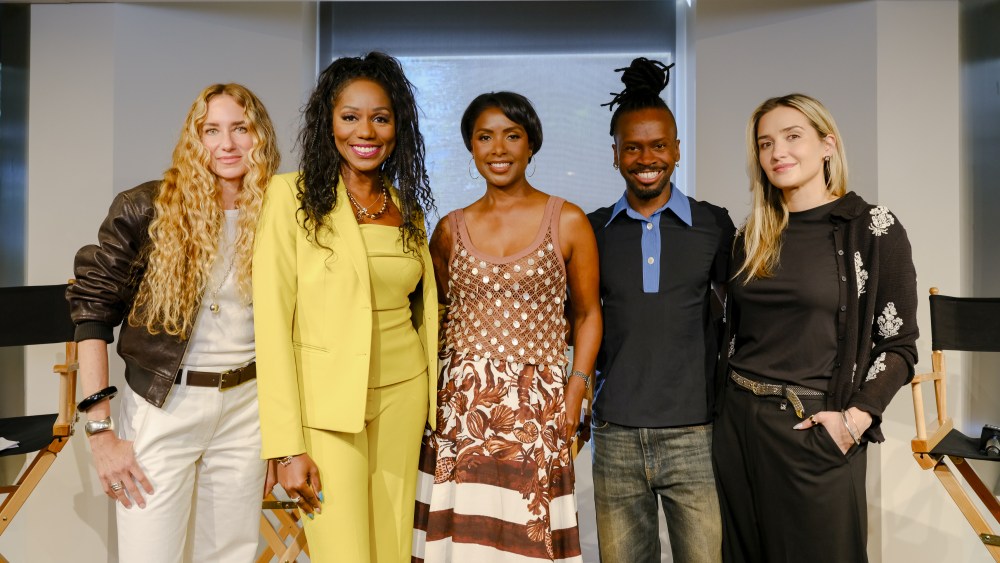
Overcoming barriers for independent designers was the hot topic Thursday night at a panel discussion titled “Made Together: Production, Funding, and the Future of Independent Fashion,” hosted by RaiseFashion in partnership with J.Crew.
The evening was followed by a cocktail celebration for the 2026 RaiseFashion Masterclass cohort and the broader RaiseFashion community.
Gena Smith, chief people officer at J.Crew Group, told WWD, “J.Crew Group is pleased to mark more than five years of partnership with RaiseFashion. Central to this collaboration is our commitment to providing emerging designers with direct access to industry expertise, actionable guidance, and the resources necessary to build sustainable fashion businesses. We are proud to welcome this year’s cohort and remain dedicated to supporting the next generation of design talent.”
Related Articles
The conversation was moderated by Felita Harris, cofounder and executive director of RaiseFashion, and was a candid discussion about the realities of production, access to capital, sustainable growth, circularity and the infrastructure independent designers need to survive in this business.
You May Also Like
The panelists included Olympia Gayot, creative director of women’s and kids at J.Crew; Chloe Marie Songer, cofounder and chief executive officer of Super Circle, a technology that makes waste circular, and cofounder of Thousand Fell, the first recyclable sneaker company; Tequila Smith, chief sustainability officer of Reworld Waste, and Edvin Thompson, founder and creative director of Theophilo, a contemporary, Brooklyn-based fashion label launched in 2016.
The focus was that designers are often asked to navigate production, funding, sustainability and growth without the same access to infrastructure or networks as larger brands. The discussion highlighted the role that mentorship, shared expertise and targeted resources can play to help emerging brands build stronger foundations. Overall the panelists emphasized the need for independent designers to join trade associations, measure waste and collaborate to build a sustainable supply chain. They called for more community and collaboration among designers.
In kicking off the conversation, Harris provided some statistics. “The industry is at an inflection point, and the need to be honest about the moment we are in is more critical than ever. There are more than 15,000 U.S. retail store closures projected. Department store sales are at their lowest since 1992. Tariffs have effectively doubled import costs for apparel and footwear in just two years,” said Harris.
She said that a rising sustainability standard is one that every brand is expected to meet, “yet access to those resources required to meet remains, as you all know, deeply unequal. The brands are being asked to do the same without a fraction of those resources.”
RaiseFashion has created the Designer Production Fund, which helps independent designers access the production support and financial resources needed to grow their businesses responsibly and sustainably.
Given the fact that the wholesale landscape has changed tremendously for independent designers so reaching new customers has changed, Harris asked Thompson how he has managed to scale and what he had to figure out.
“I’m still figuring it out. Every day is a challenge,” said Thompson. He said that it has forced him to be very inventive. He said he has been putting a lot of energy into direct-to-consumer and he will open a pop-up shop later this month with Gotham, “a really cool dispensary and lifestyle store here in New York.” It’s going to be in Chelsea from June 17 to June 24. He said the best thing to do is to focus on your community, and that direct-to-consumer has been his safety net.
J.Crew’s Gayot was asked how important it is for an independent designer building in a more complex retail environment to have a clear creative identity. She was asked what smaller brands can do to win.
“I think having a clear creative identity is number one. You all have to trust your instinct, the things that you started with, the reason that you’re here, the things that drive you every day, and what you love about what you do and showing that to your customer through DTC,” said Gayot. She said fortunately designers are able to share their story with their customers on social media.
With all the disruption that has happened over the past six years, from retail contraction to trade policy and tariffs, the panelists were asked, what is the industry’s responsibility to the designers carrying the most weight?
Songer explained that she runs an independent sneaker brand with just under $2 million in revenue. “We could not import product for seven months this last year. We manufactured in Brazil, with a 100 percent tariff fight between the current administration here and [Jair Messias] Bolsonaro and Brazil.” They had products sitting in Canada and Mexico, and sales dipped. “When you can’t ship to customers, and when you lose connection with your DTC customer…they’re gone. It’s a tough market. They’re on TikTok, they’re on Instagram, and they’re onto the next, they’re buying the next sneaker.”
In her other role at Super Circle, she said she’s spent a lot of time lobbying and working alongside some of their larger brand partners with big industry lobbying groups such as the American Apparel and Footwear Association and the American Circular Textiles Association. She said one of the things that’s frustrating is there aren’t often exclusions for brands that do under $20 million or $50 million in revenue. One of the things she’s been focused on in waste policy is exclusions for brands [generating] $10 million and $50 million in revenue.
On the topic of tariffs, if an independently privately owned brand doing under $10 million could have been excluded “that would have been radically life changing, and made a huge difference to our business this past year,” said Songer.
Smith of Reworld Waste said that if there isn’t a threshold for you to be at the table in Washington, D.C., or the state capital, “join a trade association that can make sure they represent your voice.”
“One of the verticals that I lead for Reworld is federal and state government. So one takeaway that I would love for this class to have is, if you’re not at the table, you’re on the menu. So if you don’t have a voice there, look for an organization that has a like-minded value system. Join that group, and if it’s too expensive, advocate for yourself. Ask for an independent brand entry cost of a payment system, whatever. But you have a voice and you have a right to use it in the state level and the federal level.”
Smith reminded the audience that the industry makes a lot of waste, some 92 million tons a year globally, so that equates to about 10 percent of carbon emissions globally. She said that smaller brands can pivot much more quickly than large corporations. She said you can’t measure if you’re not counting how much waste you are producing now, how much supply waste is in your manufacturing system, and how much water intensity you are using.
She urged the young designers to think about one question they haven’t asked their manufacturing team or suppliers, so they can start a conversation. She said it’s important to be curious and be consistent.
Gayot was asked why it’s important for established brands to work with emerging ones and what they gain from that knowledge.
“I think we both win when we work together. I love collaborations. I love partnerships. It’s been a big part of what I’ve been working on at J.Crew, and I think I’m just so inspired by the talent that the designers have in America. And we love to find people that we can partner with and we can share their voice with our customer, and vice versa,” said Gayot.